The short answer: you probably can't reliably guess — research on "empathic accuracy" shows even long-term partners misread each other's day-to-day emotions far more often than they think. What works instead: track shifts from their normal baseline, name what you see gently ("you seem quieter tonight"), and — the step most couples skip — agree on an explicit, low-effort signal so feelings don't have to be decoded at all. That last part is exactly what a couples mood tracker does.
Why guessing fails (even when you know them best)
Psychologists measure how well partners judge each other's feelings and the results are humbling: accuracy is modest for big, loud emotions and worst for the quiet ones — tired, drained, anxious, "off." Two things get in the way:
- Confidence isn't accuracy. The longer we're with someone, the more certain we get about our reads — while actual accuracy stays flat. We stop checking and start assuming.
- Low-intensity moods have no tells. A partner who's 6/10 stressed looks almost identical to one who's fine. By the time it's visible, it's usually already a conflict.
The cost isn't just missed comfort. Misreads get interpreted as indifference — "they didn't even notice" — which is how small moods become big arguments.
What actually works: 4 habits
1. Learn their baseline, not "the signs"
Generic body-language advice is noise. What matters is deviation from their normal: the partner who usually narrates their day going quiet, the texter sending one-word replies, the night owl heading to bed at nine. Track the delta, not the behavior.
2. Name, don't interrogate
"What's wrong?" puts someone on trial and invites "nothing." Observations land softer: "You seem flat tonight — long day?" You're offering a door, not demanding a confession.
3. Make space without a deadline
Some people process out loud instantly; others need two hours and a snack before they can say "work was brutal." Saying "no rush — I'm around when you want to talk" reads as safety, and safety is what makes feelings speakable.
4. Agree on an explicit signal
This is the one that changes everything. Couples who stop relying on mind-reading agree on a lightweight way to say "here's where I'm at" that costs almost nothing in the moment — a color, an emoji, a word. No performance, no essay, no "we need to talk" energy.
💡 The insight
The couples who feel most "in sync" aren't better mind-readers. They've just made the invisible visible: they exchange a tiny, honest signal every day, so nobody has to guess from across the couch.
How to make feelings visible with Hueband
Hueband is that signal system, built as an app for two. Here's the whole loop:
- Pair privately. You and your partner connect with a one-time invite code. No profiles, no feed, no followers — it's just the two of you.
- Tap how you feel. One tap on a mood — Happy, Overwhelmed, Loved, Drained — or a custom one you created together (inside jokes encouraged).
- They see it in seconds, everywhere they glance. Your mood appears on their phone, their Apple Watch face or Wear OS watch, and their home-screen widget. "Stressed" before they walk in the door changes the whole evening.
- Add the story when it helps. An optional one-line note — "Long meeting. Lots of feedback to process." — gives context without a conversation when there's no energy for one.
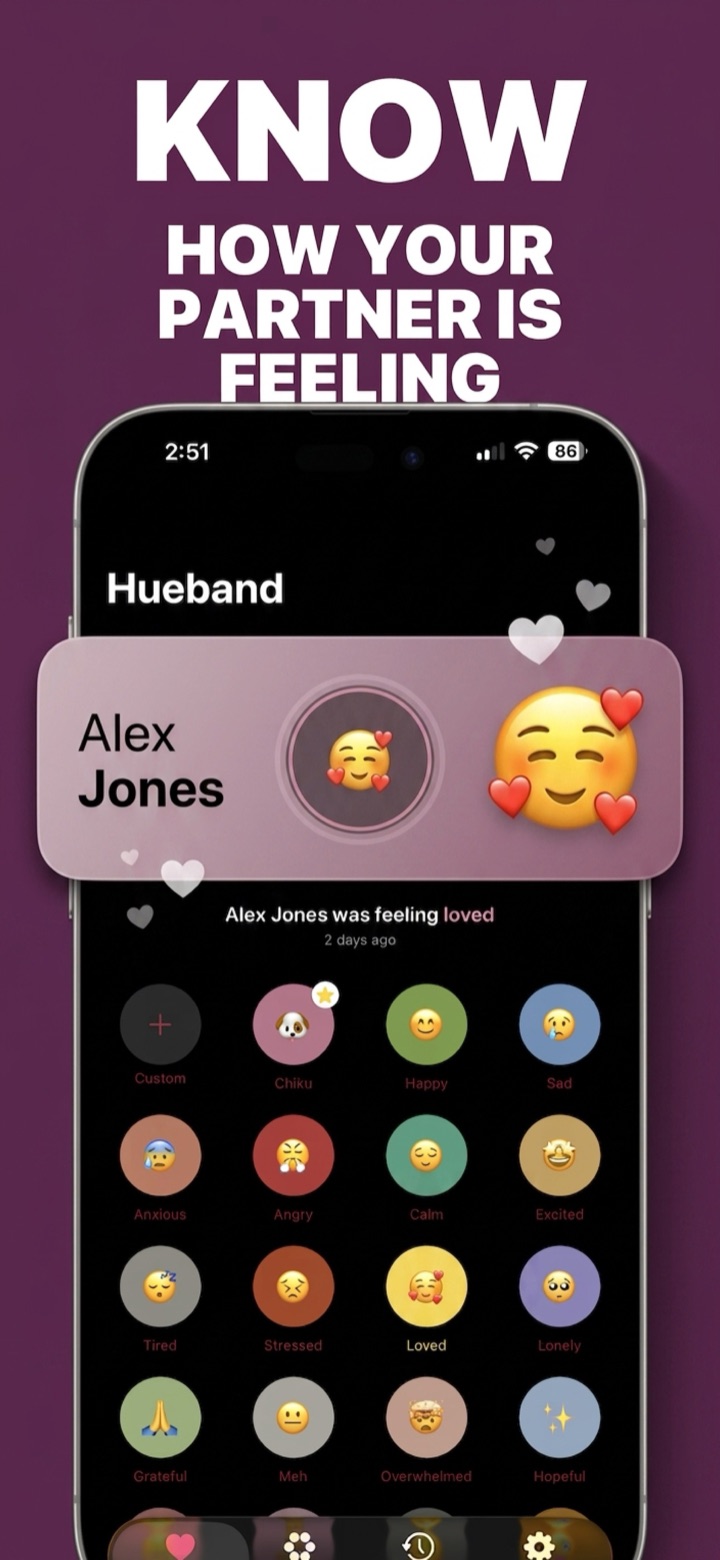
Over the week, both partners' check-ins build a shared mood ring — two rings, your days and theirs — with a sync score showing how often you were emotionally in step. It turns "how are we doing?" from a vibe into something you can actually see.

Common questions
How can I know how my partner is feeling without asking?
Track deviations from their baseline, name what you observe without interrogating, and set up an explicit signal system. Hueband makes the signal effortless: one tap and your partner's mood shows up on your phone, watch, and widget.
Why do I keep misreading my partner's emotions?
Empathic accuracy — the technical term for reading a partner's feelings — is unreliable even in close, happy couples, and worst for quiet, low-intensity moods. It's a human limitation, not a relationship failure. The fix is making feelings explicit, not guessing harder.
Is there an app that shows your partner's mood?
Yes — Hueband. Each of you taps how you feel; the other sees it live, privately, on phone, watch, and home screen. It's free to start, and one Pro subscription covers both partners.