The short answer: on a classic mood ring, dark blue and violet mean happy or in love, blue means calm, green means neutral, amber means unsettled, gray means anxious, and black means stressed — or, more honestly, cold hands. The ring never read your emotions; it read the temperature of your finger with thermochromic liquid crystals. Below is the complete color chart, the real science of what the ring measures, and what a mood ring that actually tells the truth looks like in 2026.
The mood ring chart: what each color means
Mood ring color meanings come from the charts makers printed in the 1970s, and those charts never fully agreed with each other. The table below merges the classic chart with the extra colors modern novelty rings add, ordered roughly from the coldest reading to the warmest — because temperature, not feeling, is what the ring is actually sorting by. The third column is the part most charts leave out.
| Color | Traditional meaning | What it usually meant in practice |
|---|---|---|
| Black | Stressed, tense, overwhelmed | The coldest reading. Cold hands, a cold day, or crystals damaged by heat or water and stuck on black for good. |
| Gray | Anxious, strained | A notch warmer than black. Usually just cool skin, not a crisis. |
| Brown | Restless, on edge | A cool finger. Common in the first minutes after coming in from outside. |
| Amber / Yellow | Unsettled, mixed emotions | Slightly below-average finger warmth. The in-between band on most rings. |
| Green | Neutral, active, "normal" | Average finger temperature. The default color of a working ring at room temperature. |
| Blue-green / Teal | Relaxed, inwardly calm | Slightly above-average warmth. Often just sitting comfortably indoors. |
| Blue | Calm, at ease | A warm, well-circulated finger. A warm room produces this as reliably as a good day does. |
| Dark blue | Happy, affectionate | Warmer still. Frequently spotted right after a shower or while holding a hot mug. |
| Violet / Purple | Passionate, euphoric, in love | The warmest band on the classic scale. Wonderful marketing; mostly very warm skin. |
| Pink | Affectionate, warm-hearted | A modern novelty-chart color. Placement varies by maker, usually near the warm end. |
| Red | Excited, passionate, or agitated | Maker-dependent. Some rings put red at the warm extreme, others near the cold end as an "alarm" color. |
| Orange | Stimulated, daring, nervous energy | Another maker-dependent color, typically sitting between yellow and red. |
If your ring's chart disagrees with this one, neither of you is wrong. There was never a standard calibration: each maker tuned their crystals a little differently and wrote their own poetry to match. And a ring that shows black for weeks isn't diagnosing chronic stress — thermochromic crystals degrade with heat and water, and a dead ring fails to black.
A 90-second history: 1975 and the liquid crystal
The mood ring appeared in New York in 1975, created by inventors Josh Reynolds and Maris Ambats, who sealed a thin layer of thermochromic liquid crystal under a clear dome and set it into a ring. It launched as a luxury item, was cloned within months, and became one of the defining fads of the decade.
The underlying technology was real, and still is. The same class of liquid crystal shows up in strip thermometers, aquarium thermometers, and battery-charge testers. As temperature changes, the crystal's molecular structure twists, and the twist changes which wavelength of light it reflects: different temperature, different color. The engineering was honest. The marketing was where things got creative.
Do mood rings actually work?
It depends on what "work" means. As a rough thermometer for your finger, more or less. A typical ring is tuned so that average finger-skin temperature — roughly 82 to 91°F (28 to 33°C) — lands in the green-to-blue band, with cooler skin sliding toward amber, gray, and black, and warmer skin toward dark blue and violet.
As an emotion detector, no. There is a kernel of truth: acute stress can constrict the blood vessels in your hands and cool your fingertips, while deep relaxation can warm them. But peripheral skin temperature is pushed around far more by everything else — room temperature, wind, a cold glass, caffeine, exercise, and the natural differences in circulation between people. The emotional signal is small and buried in noise, and no maker ever validated a color-to-feeling mapping. So when people ask "what do mood ring colors mean," the honest answer is: they mean your finger is at a certain temperature. If you want to know how someone actually feels, the ring can't tell you — and as we cover in how to know how your partner feels, guessing from their face isn't much more reliable.
💡 The insight
A mood ring never knew your mood; it knew your finger temperature. But the wish it sold was real: a way for feelings to be visible at a glance, without anyone having to ask. The fix was never better crystals. It was letting you choose the color.
The idea people loved was right
Strip away the pseudoscience and the mood ring was a brilliant interface. One glance at a hand and you knew — or believed you knew — how someone was doing. No interrogation, no "we need to talk" energy. That's why the idea refuses to die: feelings are genuinely hard to say out loud, and a color is a much lower bar than a sentence, which is the whole argument of our guide to expressing feelings without words. The mood ring's only real mistake was letting skin temperature pick the color.
The modern version flips that: you pick the color, on purpose, because it's true. That idea now powers a whole category of shared mood tracker apps — and it's the idea Hueband is built around, for the person whose ring you'd most want to read in the first place.
The 2026 mood ring: two rings, colors you chose
Hueband is a private mood-sharing app for couples that literally ends every week in a ring. Here's how it works:
- Tap how you feel. Choose from 20 preset moods, each with its own color, or create custom moods with any label, emoji, and color you like. Your partner approves new custom moods, so the vocabulary stays something you built together.
- They see it in seconds. Your mood appears on their phone, their Apple Watch or Wear OS watch face, and their home-screen widget. No feed, no followers, no ads on your feelings — it's just the two of you.
- Add the story behind it. An optional 140-character note gives the color context when it needs some: "Green, but barely. Long day."
- Watch the week become a ring. Your check-ins draw a weekly two-ring chart: the outer ring is your week, day by day, and the inner ring is your partner's. A couple sync score shows how often you were emotionally in step, with a per-day breakdown and 60 days of history.
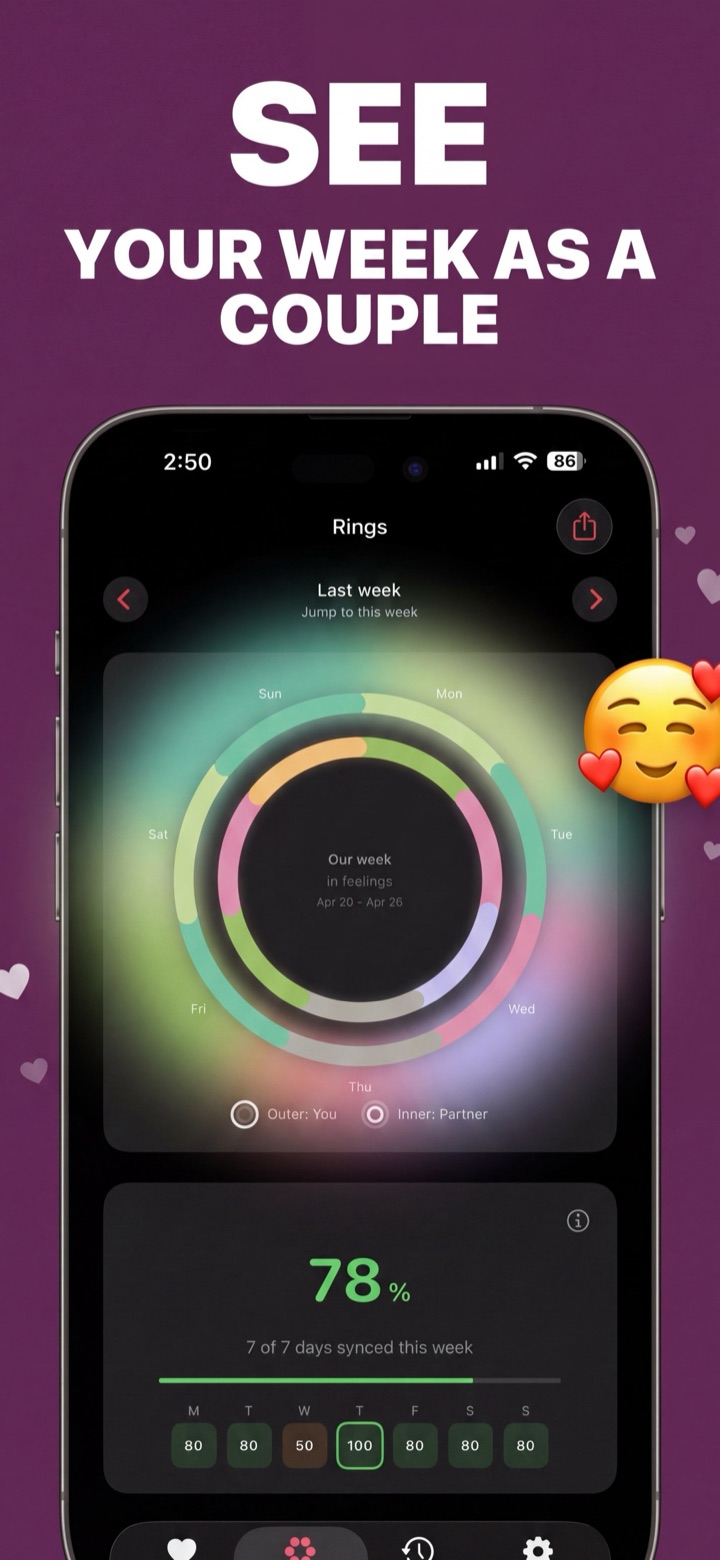
It's the 1975 object, fixed. The ring still turns colors — but the colors are honest now, because a person chose them. It's free to start (5 mood check-ins a day), and one Pro subscription automatically covers both partners.
Common questions
What do mood ring colors mean?
On the traditional chart: black is stress, gray is anxiety, amber is unsettled, green is neutral, blue is calm, dark blue is happy, and violet is passion or love. In practice, the colors track your finger's skin temperature, and calibration varies by maker — so treat any chart, including ours, as folklore with a thermometer attached.
Do mood rings actually work?
As emotion detectors, no. Thermochromic crystals genuinely change color with temperature, and strong stress can slightly cool your fingers, but room temperature, circulation, and whatever you're holding move the reading far more than feelings do. No mood ring maker has ever validated a color-to-emotion mapping.
Is there a modern app version of a mood ring?
Yes — Hueband is a digital mood ring for couples. Each partner taps how they actually feel, the other sees it on their phone, watch, and widget within seconds, and the week builds a two-ring chart with a couple sync score. It's free to download on iPhone and Android.