The short answer: if you freeze when it's time to say how you feel, you don't need more courage or a bigger vocabulary in the moment — you need a lower rung on the ladder. There are three: a fill-in-the-blank script you can copy, writing it instead of saying it, and — on the days even one sentence is too much — sending a single color or emoji that says "here's where I am." Expressing feelings in a relationship is a skill with an on-ramp, and the on-ramp can be as small as one tap.
Why the words won't come (and why it isn't a character flaw)
Naming an emotion is real cognitive work, and it's hardest exactly when it matters most: mid-stress, mid-conflict, when you're flooded and someone is waiting for your answer. Plenty of us also grew up in homes where feelings weren't named out loud, so there's no practiced vocabulary to reach for — being asked "what are you feeling?" is like being asked to describe a wine in words nobody ever taught you. Then performance pressure finishes the job: you can feel your partner waiting for the right answer, you're afraid of saying it wrong, so you say nothing — and the silence gets misread as "doesn't care," which is the opposite of what's happening inside you.
If you've ever typed "I don't know how to express my feelings to my boyfriend" — or girlfriend — into a search bar at 1 a.m., you're in enormous company. The fix isn't pushing harder at the top of the ladder. It's starting on the rung where your feet actually are.
Rung 1: I-statement scripts you can copy tonight
The I-statement shape is simple: "I feel [emotion] when [situation], because [why]. What would help is [request]." When even that feels like too much scaffolding, borrow one of these whole:
- "I'm not sure what I'm feeling yet, but something's off — and I didn't want you to think it's about you."
- "I feel overwhelmed when plans change last minute, because I lose the picture of my day. A heads-up text would really help."
- "I've felt distant this week and I don't like it. I don't have the why yet. Can we just sit near each other while I figure it out?"
- "That joke at dinner stung. I know you didn't mean it that way — I just needed to say it out loud instead of carrying it."
- "I'm at about a 4 out of 10 today. Nothing you did. I wanted you to know instead of guessing."
- "There's something I want to talk about and I'm nervous I'll say it badly. Can you be patient with the first draft?"
That last one matters most. "First draft" framing lowers the stakes for both of you: you're allowed to say it imperfectly now and revise it later. Perfectionism is the enemy of every hard conversation.
Rung 2: Write it, don't say it
Speaking is a live performance — your partner's face watching yours while the sentence lands. Writing removes the audience. Text from the next room. Leave a note by the kettle. Draft the message at lunch and send it at three. This isn't cowardice; it's bandwidth management, and many people discover they can find the words instantly once nobody is watching them search. If talks tend to derail, agree on "text first, talk after": the message gives the conversation a starting point neither of you has to improvise under pressure.
Rung 3: When even a sentence is too much, send a color
The lowest rung is the most underrated: you don't have to explain a feeling to share it. Pick a signal that stands in for you — an emoji, a color, a word you both defined earlier — and send that. A tap is an honest signal with zero performance pressure: nothing to phrase, no tone to get wrong, nothing to perform. And it tells your partner the one thing silence never can: I'm still here, and here's the weather. This is how to express your feelings when the words won't come — you skip the words and keep the honesty.
This rung is exactly where Hueband lives.
💡 The insight
A small true signal beats a perfect paragraph that never arrives. Your partner isn't grading your eloquence — they just want to stop guessing. "Orange today" reaches them; the essay you never finish doesn't.
How to build a shared emotional vocabulary with Hueband
Hueband is a private mood-sharing app for couples that turns the color-instead-of-sentence idea into a daily practice:
- Pair privately. One invite code, just the two of you. No feed, no followers, no audience — and performance pressure lives in audiences.
- Start with the presets. Tap one of 20 moods and your partner sees it within seconds on their phone, watch, and home-screen widget. On the hardest days, that tap can be your entire contribution — and it's enough.
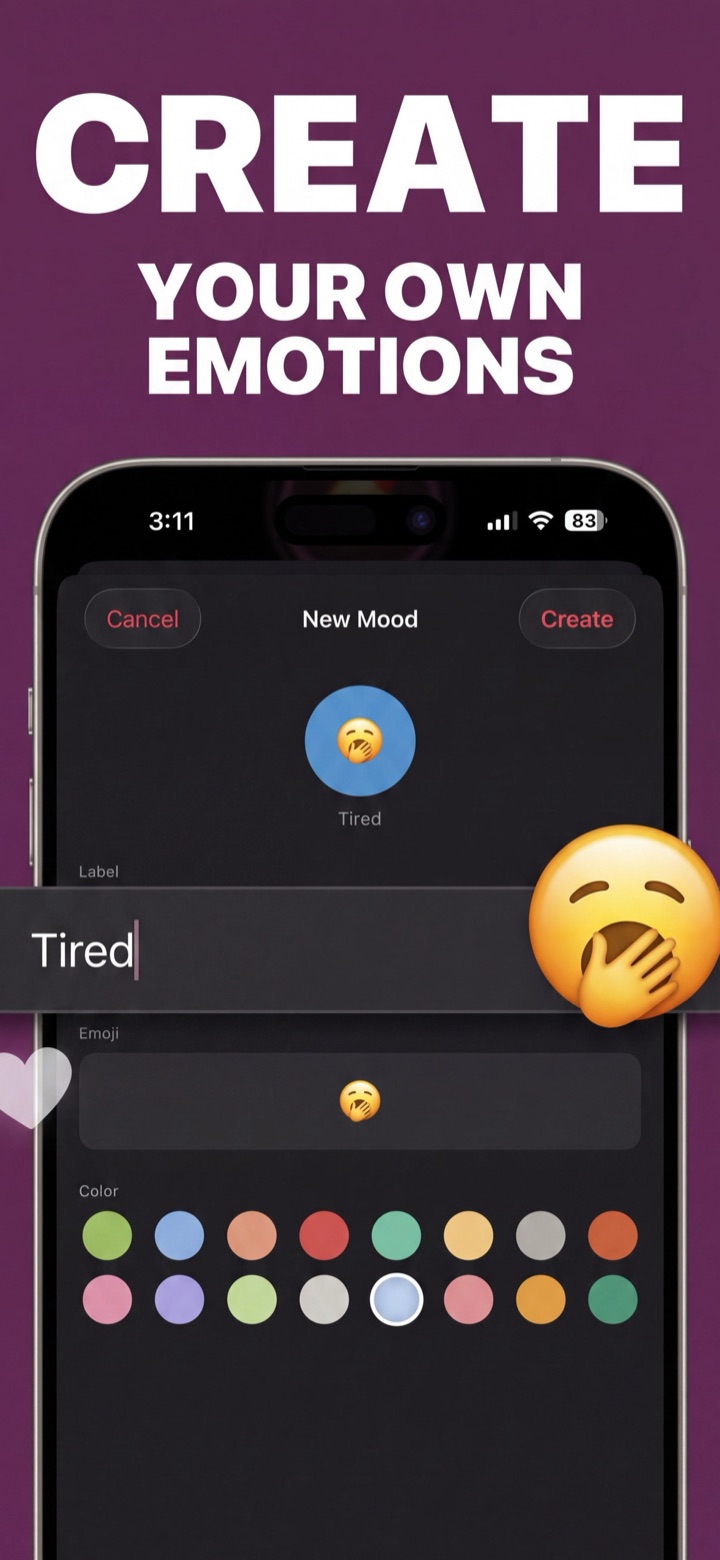
- Create the words you actually need. A custom mood is any label, emoji, and color: "Peopled out." "Pre-coffee." "Goblin mode." The feelings you actually have, not the ones a designer guessed at. Inside jokes become vocabulary.
- Approve each other's new moods. When you create a custom mood, your partner approves it before it joins the set. That's the quiet genius: every new word is a tiny conversation about what it means, so you build the dictionary together — shared language, not private code.
- Add the story when 140 characters feels doable. The optional note — "the story behind it" — is for days when one line is manageable but a conversation isn't. A sentence you write once beats a talk you keep postponing.
- Let the week do some talking. Your taps build a weekly mood ring — your ring and theirs, with a sync score — a low-words way to open the bigger conversation: "your week looked heavy; want to tell me about Thursday?"
Over time the ladder works in reverse: the daily tap keeps the channel warm, the notes get easier, and the spoken conversations start from understanding instead of from zero. Pair it with a five-second daily check-in and the hardest part — starting — disappears.

Common questions
How do I tell my partner how I feel if I always freeze up?
Start lower on the ladder instead of pushing harder. Use a fill-in-the-blank I-statement, write it in a text instead of saying it out loud, or send a single color or emoji that stands in for the feeling. Small honest signals, sent often, build the safety that eventually makes the bigger words speakable.
Why is expressing feelings in a relationship so hard for me?
Naming an emotion is genuine cognitive work, and it's hardest under stress — exactly when it matters most. Many of us also grew up without much practice putting feelings into words, and the pressure of saying it right in front of someone makes it worse. It's a skill you can build, not a character flaw, and it gets easier when the first step is tiny.
Can an app really help me express my feelings?
An app can't feel for you, but it can lower the cost of sharing. In Hueband, one tap sends your mood to your partner's phone, watch, and widget within seconds; custom moods let you build a shared emotional vocabulary together, with your partner approving each new one; and the optional 140-character note carries the story when a conversation feels like too much. It's a signal layer, not therapy.