The short answer: almost every popular mood tracker is single-player. Daylio and Moodflow are excellent mirrors — you log, you learn about yourself — but nobody else ever sees the picture, which is why people end up screenshotting their charts to send to a partner. A shared mood tracker flips the purpose: two people log how they feel and both see it, live. If you want that without duct tape, Hueband is a mood tracker built for two — both of you check in, both of you see it within seconds on phone, watch, and widget, and the week rolls up into a shared ring with a sync score and 60 days of history.
Why solo mood trackers leave your partner guessing
Search "Daylio for couples" and you'll find the same workaround again and again: track your mood solo, then screenshot the chart and text it over. It works, sort of — once a week, after the fact, when someone remembers.
The problem isn't Daylio. It's that solo trackers are designed for retrospective self-insight: what patterns show up in my month? That's genuinely valuable. But a relationship runs on something different — current awareness. Your partner doesn't need your February trend line; they need to know that today is a heavy day while it's still today. A screenshot is a report. What couples actually want is a window.
What a mood tracker you can share has to get right
Both people log, and both people see it live
One-way sharing (you export, they receive) recreates the screenshot problem with extra steps. In a real shared tracker, each entry appears for the other person automatically, in seconds — no export button, no "remind me to send it."
The history belongs to both of you
A shared tracker should answer "how was our week?" — not just "how was mine?" That means a view where both timelines sit together, so you can spot things like your stressful Tuesdays landing on their calmest days.
Reminders that invite, not nag
Streaks and guilt-trip notifications kill shared tracking fast, because now you're disappointing a person, not an app. Gentle beats gamified: a soft nudge when someone's gone quiet, and nothing more.
The mood trackers two people can actually use
Daylio — best solo tracker, with the screenshot workaround
Honest verdict: if you want deep personal analytics and journaling, Daylio is still the best-in-class solo tracker, and no couples app matches its statistics. But there is no partner sharing at all. Keep it for self-insight; just don't ask it to keep two people connected.
Moodflow — the quantified diary
Moodflow is another capable solo tracker in the same family: rich logging, no shared layer. Same verdict as Daylio — a mirror, not a window.
Shared Mood — a tiny widget for two
Shared Mood is a small indie couples widget app: minimal, charming, and much lighter than a full tracker. Worth a look if all you want is a mood on a home screen.
MoodMe — couples mood sharing, phone-only
MoodMe is a couples mood app with a big library of moods to pick from. Its gap is everything around the phone: there's no wearable story, so the mood lives in an app you have to open.
Hueband — the full shared loop
Hueband is a mood tracker for two, end to end. You tap one of 20 preset moods — or custom moods you create with any label, emoji, and color, which your partner approves so the shared vocabulary stays mutual. An optional 140-character note, "the story behind it", adds context. Your partner sees the check-in within seconds on their phone, their Apple Watch or Wear OS watch, and their lock-screen or home-screen widget. The week becomes a two-ring chart — outer ring you, inner ring them — with a couple sync score, a per-day breakdown, and 60 days of history on your device. And it's not couples-only: separate private circles (up to 4 people each) let you share with family or a best friend, and no circle ever sees another.
About "notify me when my partner is sad"
A lot of people arrive at shared tracking through this exact search, and it deserves a careful answer. An app that inferred your partner's sadness and reported it to you would be surveillance, and it would corrode the trust it was meant to protect.
The healthy version of that wish is consent-based: your partner tells the app how they feel, and the app makes sure you actually see it — within seconds, on whatever screen you glance at first. Hueband shares only what your partner chooses to share. That choice is what makes the signal meaningful: when "having a rough day" reaches your watch, it's because they wanted you to know. And if someone simply goes quiet, Hueband sends a gentle nudge — an invitation to check in, never an alarm about them.
💡 The insight
A solo tracker asks "what patterns am I missing about myself?" A shared tracker asks "what is my person carrying right now?" Different question, different tool — and most couples discover the second question matters more on an ordinary Tuesday.
How to start tracking moods together with Hueband
- Both install the app. iPhone or Android — mixed iPhone-Android couples work fine, and the watch apps cover Apple Watch and Wear OS.
- Pair with a one-time invite code. Private by design: no feed, no followers, no ads on feelings.
- Check in once a day (or whenever it shifts). Tap a mood; add the story behind it when context helps. Free covers 5 check-ins a day each.
- Glance instead of asking. Widgets and watch faces always show your partner's latest mood, so awareness happens in passing.
- Review the week together. Open the weekly rings, look at the sync score and the per-day breakdown, and let the odd mismatched day start a conversation.
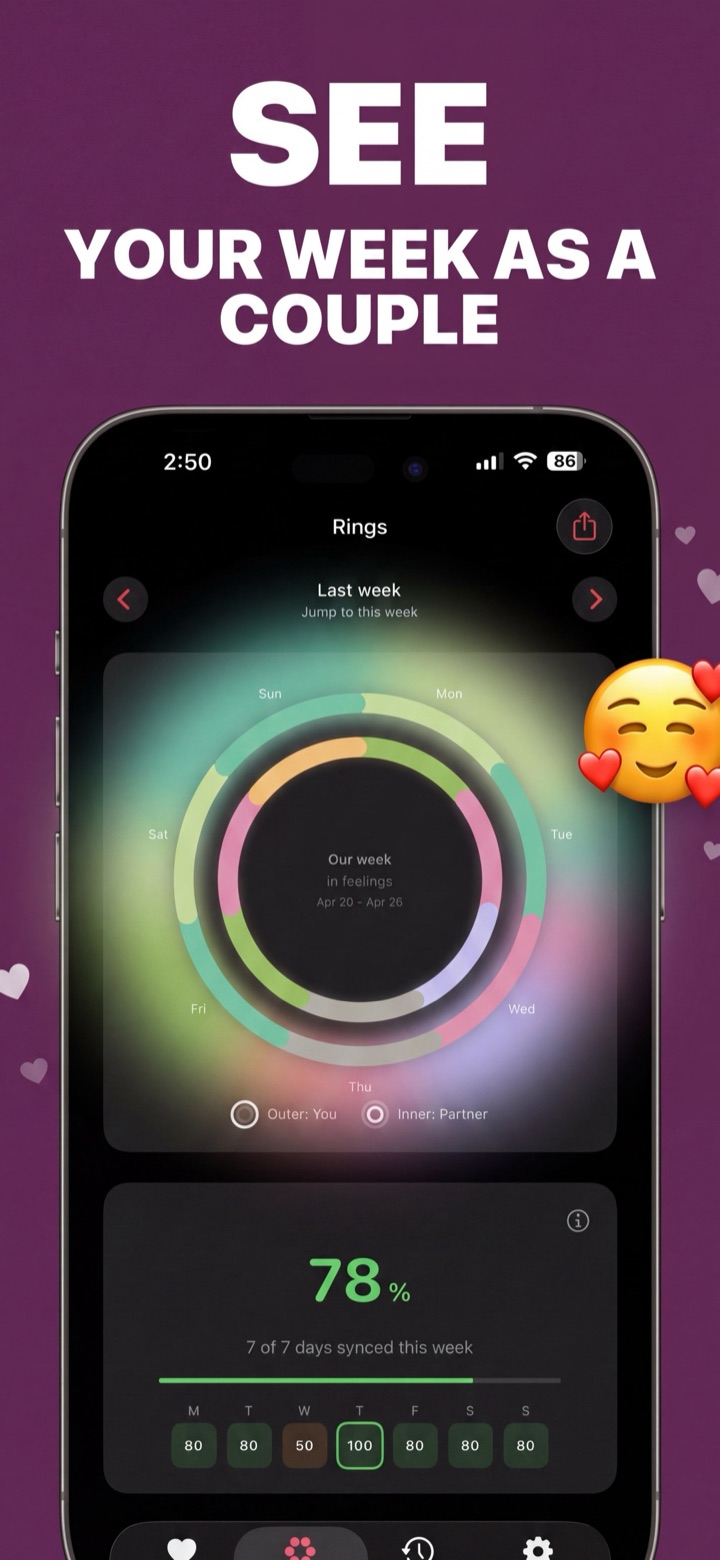
That weekly view is the payoff of sharing: the same data a solo tracker would have shown only you becomes something you read side by side — and the colors of your shared ring start to mean something to both of you.

Common questions
Can you use Daylio with a partner?
Not natively. Daylio is an excellent solo tracker and journal, but there's no partner sharing — hence all the screenshotted charts. If mutual awareness is the goal, use a tracker built for two; if deep personal analytics matter to you, it's perfectly reasonable to run Daylio for yourself alongside Hueband for the two of you.
Is there an app that notifies you when your partner is sad?
The healthy version exists: in Hueband, your partner checks in with how they feel and you see it within seconds on your phone, watch, or widget. It shares what they choose to share — a hard day reaches you through their consent, not through monitoring.
Is there a free mood tracker two people can share?
Yes. Hueband is free for 5 check-ins per person per day (15 a day during your first week), on iPhone and Android. If you want more, one Pro subscription — $8.99/month or $34.99/year — covers both partners automatically.